
August 2026 Market Update
Q3 Market Update, Marcus Musson, COO
Opinion Piece
August, the peak of the ski season and last month in our winter. There is a lure that spring is only just around the bend as lambs start emerging in paddocks and daffodils pop up all over the place. Sometimes, however, this can be a false sense of security as September can prove to be one of the wettest and windiest months on the calendar which can, in turn, create a few issues for foresters with windthrow and infrastructure damage. NIWA expects an 80% chance that El Nino will reach or exceed strong intensity by the end of September which will likely result in unusually windy conditions. This is great for drying things out but not so great for keeping trees vertical.
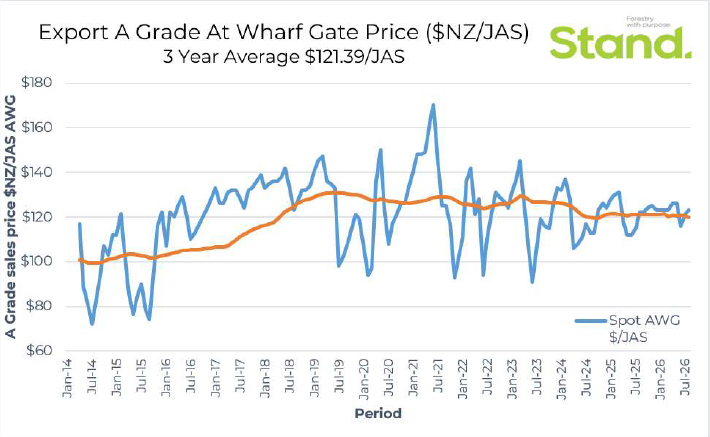
We have seen considerable wind damage over the past few years, starting with Gabrielle in 2023 and latterly with the 2025 events in the Nelson Tasman region and 2026 event in the Southern north island. This has resulted in an out-of-cycle increase in harvest volumes in these regions and pushed supply into markets when it was not necessarily needed. While these salvage operations have wound down in the North Island, the Nelson region still has some distance to go. Even though the market has not needed the extra slugs of volume resulting from the salvage operations, there has been a reasonable balance in terms of supply and demand which has kept prices on a relatively even keel for the past 12 months. While we saw a 7% drop in June; July and August have seen a rebound back above the 12-month average with A Grade 3.9m at around $125/JAS in North Island ports and around $115/JAS in South Island ports.
Economic data out of China isn’t painting a rosy picture with the Purchasing Managers Index (PMI) dropping to 49.2 from 50.3 in June indicating a softening in manufacturing activity. Probably nothing to see here as July and August are historically fizzers for PMI data. It is important to note, however, that the quarter 2 economic growth rate was the lowest in three years at 4.3% and, when combined with increased in tech exports and decreased construction activity, wood-based products are probably fearing worse than reported.
On the bright side, in market log inventories have dropped slightly to around 2.47 million cubic metres with daily offtake a shade under 60,000 cubic metres per day. NZ supply has been somewhat subdued with weather issues and problems berthing vessels in Gisborne due to successive long wave events. These events are especially frequent during southerly conditions and result in vessels being held at anchor and unable to load. This creates a backlog as the port fills quickly and stock begins to build in the forest which takes time to clear.
Shipping costs continue to be problematic with the Iran conflict keeping costs over $US40/JAS. As long as the US and Iran continue their Mexican standoff it’s unlikely that we’ll see any reductions in the near term. It’s a great time to be a fuel company with many booking record windfalls and profits in the double to quadruple range. To put it into context, the eight major fuel companies booked more than $US90 billion in profits in the 3 months following the war. Nothing like a bit of profiteering at the expense of others in a time of global crisis.
India didn’t want China to feel lonely in the PMI stats game and have recorded their lowest result in 5 years. While still above 50 (so indicating expansion), the July number of 53.5 is well back from June. While export orders grew at the fastest pace since April, job hires were at the lowest point in almost 30 months. Vessel arrivals into India are currently down around 50% on July with around 6 vessels due to berth at Kandla Port. Berthing in India is slow and complicated and recent damage to one of the berths has made this process more difficult. The rainy season has flooded many parts of North, West and central India which has in turn dropped radiata lumber demand by around 50%. Containers of logs have started turning up at Tuticorin Port from South Africa, USA, Australia and NZ. As there are no processing facilities near this port, much of the volume must be trucked hundreds of kilometers to sawmills which adds to cost and complexity.
There was a bit of excitement in the carbon game a few weeks back when the volume of the NZU’s available for sale dwindled creating a buyer flurry that saw 700,000 units sold in a day and sale prices break through $55/NZU. This in turn got the traders’ phones going and this available sale volume was quickly replaced as participants tried to capitalize on the goldrush. As with any flurry, this quickly settled down to business as usual without any significant price reaction.
The domestic market continues to show green shoots as log supply tightens and sawmill inventories recede. Pruned especially is in high demand and although this is supply related, it does show the advantage of pruning your forest. Pruned log prices continue to remain buoyant, and some sawmills are happy to help cover the additional cartage component to get supply from out of their traditional region.
RMA minister Chris Bishop has put on his big boy pants and blocked Gisborne District Councils’ $600M plan to force landowners (farmers and foresters) to transition to permanent vegetation cover. This has created the expected level of vitriol from proponents of the plan, many of whom seem hellbent on turning the East Coast into an economic and social backwater. This is the classic case of being careful what you wish for as we are already seeing significant forest related processing investment walk away from the region due to long term supply insecurity.
So, how will the rest of the year play out? If you were a betting person, you’d probably put your casino chips on increased export prices heading into the pointy end of the year. The China log futures market seems to be pricing in increased spot returns from lower supply and shrinking inventories, although the Trump induced cost equation may take the fun out of this. Either way, logs will keep flowing and the global risk roulette wheel will keep spinning flat out.