
December 2025 Market Update
Marcus Musson, Forest360 Director
December 2025 Market Update
With 2025 almost put to bed it’s time to start contemplating what next year might look like in our market space. This year has been the most stable in terms of price that we have seen since 2018 and, although the prices are not super appealing compared to the golden period a few years back, stability does provide certainty. This certainty is in the form of consistent work programs for contractors, consistent supply for our exporters and domestic sawmills and predictable returns for forest owners.
So, the 64-million-dollar question is what will next year be like? Predictions like this are always dangerous without the gift of hindsight but my bet would be more of the same. There’s nothing out there that would give an expectation of an increase in demand from China. India may give rise to some additional demand as real GDP is running at 8.2% and they are slowly getting their port infrastructure into this century. The long-anticipated FTA will help as returns to India are still marginal and fumigation remains problematic with their requirements for Methyl Bromide. There is therefore a glimmer of hope but nothing bankable or of scale at this stage.
Vietnam probably holds the most potential with demand increasing steadily, however the problem there is the lack of port infrastructure for break bulk vessels meaning most logs have to be containerized which is expensive and to top that off, the Vietnamese don’t want our lower Ki and KIS grades. Unfortunately, once you’ve sold the eye fillet, it’s sometimes hard to sell the bladders and brains so any significant volume increase into Vietnam will require a bladder and brains solution.
Taking the above into account, China is still, by far, our most important trading partner for forest products. While we have lost a significant amount of harvesting infrastructure in the past few years, successive windblow events, such as the one in Nelson, continue to put excess volume into a market that doesn’t really want it. If you look up the word ‘commodity’ in the dictionary you’ll probably see a photo of a log and to that extent, the rules of supply and demand affect log prices directly. It’s unlikely that Chinese demand will increase significantly, if at all, in the short to medium term, so we need to be very careful with our supply position post new year, especially around the traditional Chinese New Year Celebrations when the market basically stops for the best part of 3 weeks.
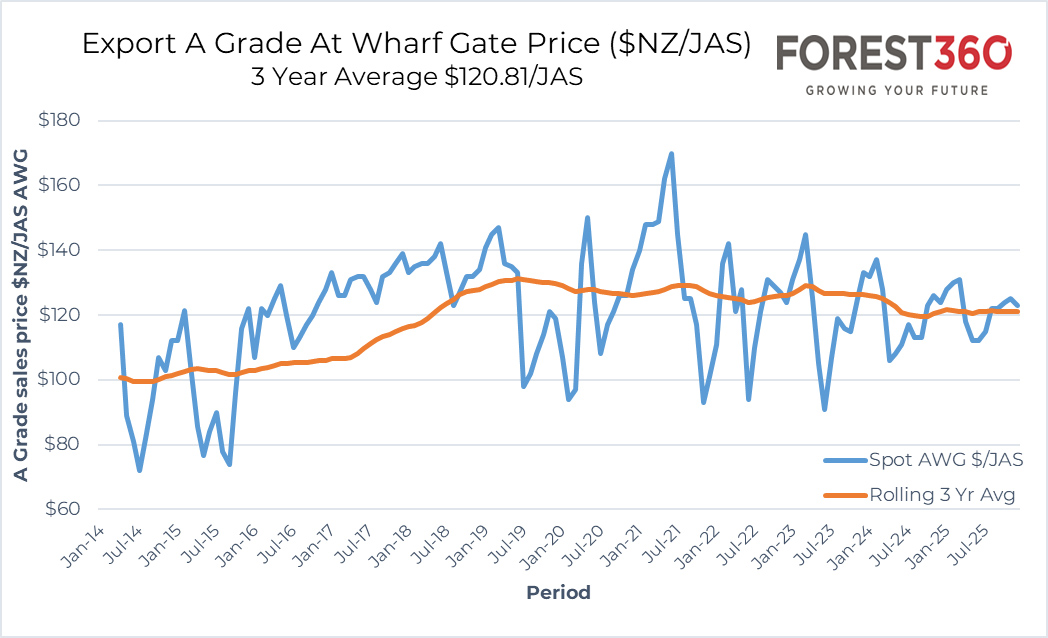
Case in point is December export prices which have come off slightly with a drop in the in-market sales price (CFR) of around $US5/m3. This is a result of slightly increased inventory and a general dour sentiment around the market. The resulting at wharf gate numbers are back between $NZ2 to $10/m3 depending on which exporter or port you’re delivering to, and this is the largest spread between exporters that we’ve seen in a few months. NZ supply will drop over the Christmas break as the holidays land perfectly for a 2-week shutdown, however this may not be enough to get inventory into pucker territory for buyers. As with the Vietnam market, buyers are chasing longer lengths and a log grade mix that is heavy to A grade.
The sooner we, as an industry, can remove the lower KI and KIS grades from the sales basket the better. There is an opportunity here in the form of converting these grades into biofuels to replace natural gas which has a 5-year lifespan – max. Unfortunately, the government seems hell bent on importing LNG which is all sorts of retarded when we don’t even have a port or distribution network set up yet. Not to mention the estimated delivered cost of LNG to a port of $20/gigajoule (plus likely the same amount again for distribution). Compare this to around $18/gigajoule for woodchips delivered to site, this seems a no brainer. Yes, there will have to be new boiler and fuel storage investment by heat users to burn biofuels, but this investment is a solid insurance policy against the insecurities (both financial and supply) of international fuel markets.
There are some winds of positivity in the domestic market with NZ residential building consents showing the biggest jump since 2022. Domestic sawmills have been struggling under depressed demand and high inventory for the most part of 2025 and hopefully, once these consents are put into action, the hammers will start swinging and demand will return. It’s unlikely that we will see this reflect in respective log pricing early in 2026, however, if the market continues in the upward direction, Q2 will see price pressure.