

November 2025 Market Update
Marcus Musson, Forest360 Director
November 2025 Market Update
November, the month of Mo-vember in NZ, Thanksgiving in the US and world vegan month. It is the month that those of us in the southern hemisphere start to get excited with some decent weather, those that can’t really grow mustaches have an excuse to give it a nudge and vegans have another reason to tell you all about being a vegan. It also means harvest activity increases in NZ as more favourable weather allows higher productivity supported by the expectation that prices will continue on a seasonal uplift.
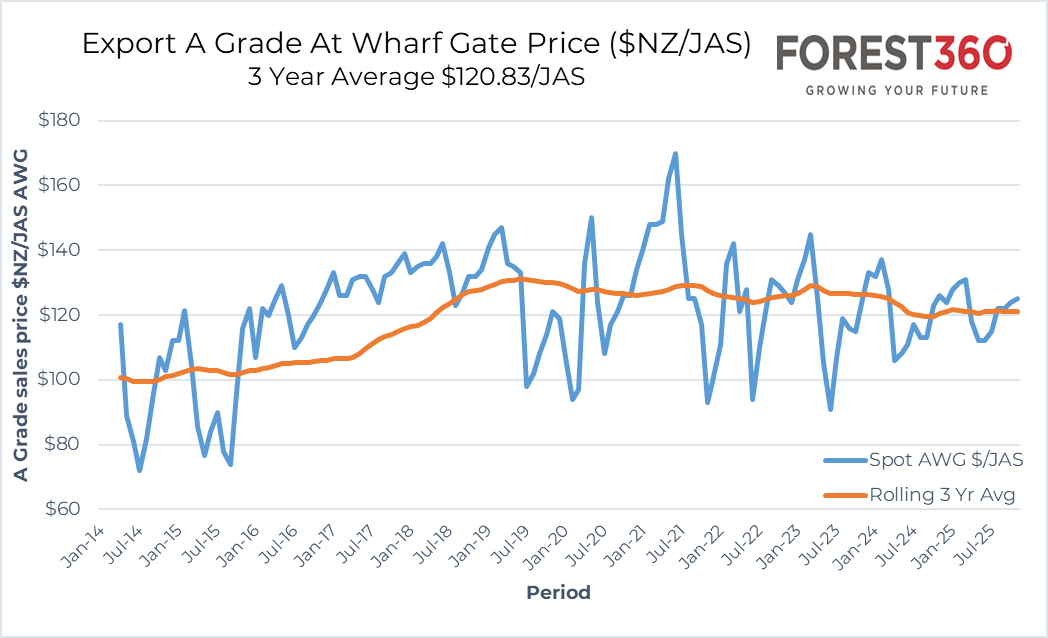
This November might be slightly different, however. There will still be vegans veganing and sketchy mustaches proudly worn, but the likelihood of a significant seasonal uplift in log prices this quarter looks rather dour. While there have been some very marginal increases in At Wharf Gate (AWG) prices this month, it is mainly due to the NZ dollar taking a bath against the US (and most other currencies) rather than increases in demand and sales price. The A grade short price at Southern North Island ports is around $125/m3 which has edged up by around a dollar month on month since August, continuing a very soft upward trajectory.
Shipping costs are back in the early $US30’s/m3 following a short spike a fortnight ago which was a result of tit for tat imposition of ‘special port fees’ between the US and China. These fees were placed on China based vessels docking in the US by the US Govt which were closely followed by the Chinese Govt reciprocating this for US based ships docking in China.
Log inventories in China are up around 150,000m3 in October to 2.7 million m3 with daily offtake in the 55-60,000 m3/day range. October did see a weeklong Golden Week holiday in China which stalled demand for a period, however at the current run rate, supply and demand are finely balanced.
The Chinese Manufacturing Purchasing Managers Index (PMI) vied with the NZD over who could take the biggest bath in October with a drop to 49.0, down from 49.8 in September. Anything under 50 indicates a contraction, and this has been the case since March this year. The flipside is the non-manufacturing PMI which covers services and construction rose from 50.0 in September to 50.1 in October. Historically the non-manufacturing PMI would have been the one to look at due to the construction focus, but now that construction is as popular in China as Takuta Ferris is in the Te Pati Māori caucus, the manufacturing PMI is more relevant as this accounts for furniture making which is overtaking construction in terms of log demand.
Thankfully Xi and Trump have stopped throwing pencils at each other and agreed to concessions on both sides to de-escalate the trade scuffle. This will be a relief to China based furniture manufacturers who were threatened with an additional 200% tariff in mid-October, however it is unlikely to result in increased demand in the short term. One thing’s for certain is that nothing’s for certain with Trump and he is just as likely to change his mind next week.
NZU’s were a bit jealous of the NZD and PMI decline and decided to join the party following a surprise proposal by the Government to reform the ETS. This proposal includes restricting the Climate Change Commission to a monitoring ability only and removing the requirement for the ETS to align with Paris Agreement targets. Market commentators were generally united with the view that the continued Government fiddling with ETS settings (from successive Governments) has significant impacts on the credibility of the scheme. Market reaction was swift with the spot NZU market dropping around $10/NZU (20%) to $42/NZU before rebounding to $46.75 as of the time of writing, effectively wiping out $1.6 billion of value from NZU holdings. The use of the ETS as a tool to cut emissions is becoming more farcical by the day and, with the Governments pre-election promise of leaving the ETS alone obviously not being adhered to, NZU price will likely stay subdued. The next NZU auction is scheduled for the 3rd of December but with the recent announcement, this is likely to be a non-event.
A few glowing embers for the domestic market with builders indicating increased quoting activity in both commercial and residential sectors. Cotality has recently released data showing property prices across NZ rose 0.2% in October which is supported by Statistics NZ data pointing to September having the highest number of new dwelling consents since November 2022. The September numbers show 3747 new residential consents were issued which was a 27% increase on September 2024. This has not yet resulted in a lift in sawlog prices, however if this trend continues, we hope that some of the price reductions in Q4 will be reversed in Q1 2026.
The pressure is still on domestic pruned prices with the cost of the US tariffs not being passed onto US consumers. Many of the NZ sawmills that operate in the US clearwood market have had to absorb the tariff costs and although some of this has been passed onto forest owners through reduced log prices, the majority will come directly off the sawmills’ bottom line.
So, with the focus now firmly on the slide into Christmas, it’s unlikely we’ll see anything remarkable in terms of increased log prices this side of New Year. With December and January being short production months we’ll be looking at starting 2026 in a comfortable inventory position with lower supply levels so there could be some upward pressure on the distant horizon. In the meantime, groom the mustache, enjoy the tofu and start drafting your letters to Santa.